Should You Fix Your Business Loan Rate Now? The Break-Even Maths After the RBA Rise
By 121 Brokers Team, Commercial finance brokerage
· 15 min read
· Published
Fixing a business loan rate pays off only if the variable rate averages more than your break-even rate over the fixed period. That break-even is the number this guide helps you find. Fixing buys certainty for a known premium and possible break costs; staying variable keeps flexibility and carries the rate risk. Neither answer suits every business.
What does fixing a business loan rate actually mean?
Fixing means the lender holds your interest rate, and therefore your repayment, unchanged for an agreed period, commonly one to five years. Cash rate moves in either direction do not touch it during that time. At the end of the fixed period the loan reverts to a variable rate the lender sets then.
The fixed period and the loan term are two different lengths. A fixed rate might run for 24 months on a loan with 60 months left. For the remaining 36 months the loan sits on a variable rate, which moves when the lender moves it. The revert rate is the lender's name for the variable rate your loan lands on when the fixed period ends.
Some lenders charge a fee to fix; others build the cost into the fixed rate. The lender sets the fixed rate, the fee, the fixed periods on offer and the revert rate rules. All of them appear in the written offer or the loan contract, which is the first document to read.
121 Brokers, a business finance brokerage, does not recommend fixing or floating; it brings back written fixed and variable quotes from a panel of lenders so the comparison uses real numbers. This guide is about term loans, not revolving facilities such as a line of credit. Before reading on, check how many months are left on your term and whether any part of the balance is already fixed.
The fixed period is usually shorter than the loan. When it ends, the loan reverts to a variable rate the lender sets at that time.
What is a break-even rate and why is it the number that matters?
The break-even rate is the average variable rate over the fixed period at which fixing and staying variable cost the same. If variable rates average above it, fixing was cheaper; below it, floating was. It turns the decision from a guess about the RBA into a single number you can compare against your assumptions and the fixed premium on offer.
The comparison counts everything you pay out during the fixed period, repayments plus any fee to fix, and the balance still owed when it ends. Adding the two gives the cost of each leg, which puts loans with different repayment sizes on the same footing.
With no fee to fix, the break-even is simply the fixed rate. A fee pushes it higher, because the variable rate now has to average more than the fixed rate before fixing recovers the fee. Our sibling guide on what the RBA rise means for business loan repayments covers what each 25 basis points does to a variable repayment.
The forecasts later in this guide are inputs to your path, not the answer. The thing to check is which side of your break-even each path lands on.
How do I work out the break-even on my own loan?
On your balance and remaining term, cost the fixed leg: fixed repayments for the fixed period plus any fee, plus the balance still owed at the end. Then find the flat variable rate that produces the same total. The calculator below does the search. Enter your fixed quote and your own variable path; it is an assumption, not a forecast.
The calculator opens on this worked example. All loan amounts and rates in this example are invented illustrations, not quotes. The 9.00% and 9.40% illustration rates sit above the RBA's 7.46% average rate on outstanding small business loans for July 2026 (RBA Statistical Table F7, published 7 September 2026). That average blends secured and unsecured lending.
Balance and term: $300,000 with 60 months left to run.
Fixed period: 24 months.
Rates and fee: current variable rate 9.00% p.a.; fixed rate offered 9.40% p.a.; fee to fix $0.
Variable path assumption: from month 2 the variable rate becomes 9.25%; from month 14 it becomes 9.00%; the third step is left blank. The path is one assumption among many; it is not what we expect to happen.
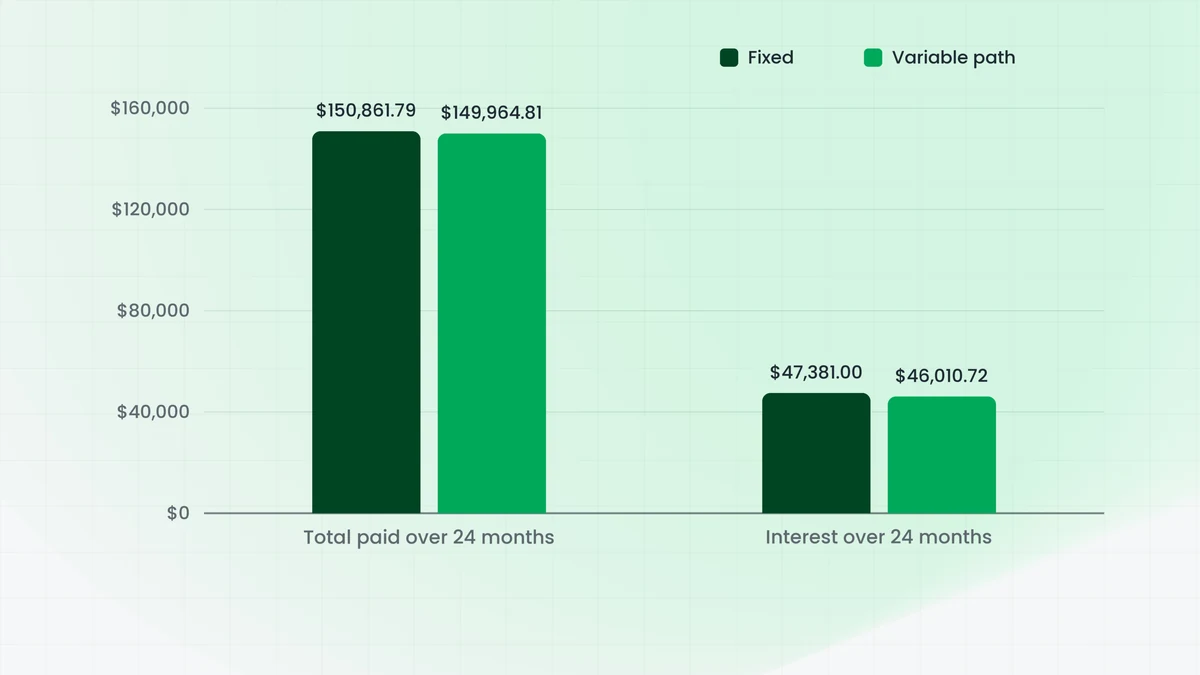
The fixed leg: at 9.40% over 60 months, the repayment is $6,285.91 a month. Over the 24 month fixed period that is $150,861.79 paid, of which $47,381.00 is interest. The balance still owed after 24 months is $196,519.21. Paid plus still owed gives a fixed leg cost of $347,381.00.
The variable leg: month 1 at 9.00% has a repayment of $6,227.51. From month 2 at 9.25% the repayment is recalculated to $6,263.42, and from month 14 at 9.00% it is recalculated to $6,234.21. Over 24 months that is $149,964.81 paid, of which $46,010.72 is interest, with $196,045.91 still owed. Paid plus still owed gives a variable leg cost of $346,010.72.
The difference: under this path the variable leg costs $1,370.28 less over the 24 months. On these assumptions, fixing would not have paid off. The path entered averages 9.125% (time-weighted: one month at 9.00%, twelve at 9.25%, eleven at 9.00%), which sits below the break-even.
The break-even: 9.40%. With no fee, the break-even is the fixed rate. The variable rate would need to average 9.40% over the 24 months for the two legs to cost the same.
Three things are worth trying once the calculator is open. First, enter a fee to fix of $600 and watch the break-even move above 9.40%, to roughly 9.5%. Second, clear both path steps so the variable rate stays at 9.00% for all 24 months. The variable leg then costs $345,295.34, which is $2,085.66 less than fixing.
Third, set a single step to 9.40% from month 1. The difference is close to zero and the break-even equals the fixed rate, which is the sanity check. Then enter your own balance, term, fixed quote and fee from the written offer. Whatever variable path you enter is your assumption, not a forecast.
Interactive calculator
Fix or Float Break-Even Calculator
$
$1,000 to $10,000,000.
What you still owe today.
1 to 360 months.
1 to 60 months.
Cannot be longer than the remaining term.
%
0.10% to 40.00%.
The 9.00% default is an illustration, not a market rate.
%
0.10% to 40.00%.
The 9.40% default is an illustration, not a quote. Use the rate a lender has actually offered you.
$
$0 to $50,000.
Any rate-lock or switching fee the lender charges to fix.
Break-even variable rate
9.40%
The variable rate would need to average 9.40% over the 24 months for the two to cost the same.
Your path averages 9.13%, below the break-even rate, so staying variable costs less under your assumptions.
Fixed rate versus your variable path over the first 24 months
Figure
Fixed
Variable path
First repayment
$6,285.91
$6,227.51
Total paid over the period (including any fee to fix)
$150,862
$149,965
Interest over the period
$47,381
$46,011
Balance still owed at the end
$196,519
$196,046
Cost (total paid plus balance owed)
$347,381
$346,011
Under your variable path, staying variable comes out $1,370 cheaper over 24 months.
Break costs if you leave a fixed rate early are not included. Fixed rates, fees and terms are set by each lender.
Cost adds what you pay over the fixed period to the balance you still owe at the end, so two legs with different repayment sizes compare fairly.
On the variable leg the repayment is re-solved on the remaining balance and term each time your path changes the rate.
The break-even figure is the flat variable rate that would cost the same as fixing. Your path average is the simple average of the monthly rates you entered.
The pre-filled rates, balance and path are illustrations, not typical or market pricing, and not a forecast.
Estimate only, for general information. Not financial advice, a quote or an offer of finance.
Actual rates, fees and repayments are set by the lender and subject to approval and your circumstances.
Two caveats, in the calculator's own words. Break costs if you leave the fixed rate early are not included. Fixed rates, fees and terms are set by each lender. Check the written offer for the exact fixed rate, fee and fixed period before you rely on any run.
The invented example over 24 months. The variable path costs $1,370.28 less; a different path, or a fee to fix, changes the answer.
What are break costs on a fixed business loan?
A break cost is the amount a lender charges if you repay, refinance or restructure a fixed-rate loan before the fixed period ends. It reflects the lender's own cost of unwinding the fixed funding and can be large when rates have fallen since you fixed. The formula is in your contract. Ask for the current figure in writing before deciding.
Break costs tend to bite in three situations. One is an asset sale during the fixed period. Another is a refinance to an offer that looks cheaper until the break cost is added, and the third is early repayment from a windfall.
Unlike a flat early payout fee, a break cost is calculated from rate movements since you fixed and the time left on the fixed period. It can be nil one month and thousands of dollars another. Both sit inside the payout figure the lender issues when you ask to close the loan.
When does fixing tend to suit a business, and when does staying variable?
Fixing tends to suit a business that needs a known repayment for the fixed period, has thin margin for surprises, and does not expect to repay or refinance early. Staying variable tends to suit one that may sell an asset, repay early or restructure, or that can absorb a rise and wants the upside of a fall.
The $60 a month swing in the first row is about the gap between the two opening repayments in the worked example, $6,285.91 fixed against $6,227.51 variable. Repayment cover means how many times over your monthly cash surplus covers the repayment. Our sibling guide on how much buffer a business needs after the rate rise has a stress test.
Fixing and staying variable, situation by situation
Your situation
Fixing tends to suit when
Staying variable tends to suit when
What to check
Repayment certainty
Margin is thin and a $60 a month swing matters
Margin absorbs swings comfortably
Your surplus after repayments, and the stress test in our buffer guide
Plans to repay or refinance early
None in the fixed period
Likely
The break-cost formula and today's indicative figure
Margin headroom
Small
Large
Repayment cover now and after a 100 point rise
Expected asset sale
None
Probable
Whether the facility is secured on that asset
Appetite for break costs
Nil
Can carry them
The worst-case break figure in writing
Access to a split
Wants certainty on part only
Same
Whether the lender offers a split and on what terms
No row is a recommendation. Work down the last column with your own facility in front of you and note which checks you cannot yet answer.
Can you fix part of the loan and leave the rest variable?
Often, yes: some lenders allow a loan to be split into a fixed portion and a variable portion. That caps the exposure to a rise on part of the debt while keeping flexibility on the rest. Not every lender or product offers it, and each portion carries its own terms. Ask whether a split is available before assuming either extreme.
What about equipment finance?
Many equipment finance contracts are written at a fixed rate for the whole term, so the fix-or-float question often does not arise. Some are variable, so check the contract. Security can also affect the fixed offer; see secured and unsecured business loans compared and our secured business loans page. The line to check on an equipment contract is the one that says whether the rate is fixed, and for how long.
How long should I fix a business loan for: one, two, three or five years?
A shorter fixed period costs less certainty and ends sooner, so the revert-rate risk arrives sooner. A longer period holds the repayment through more RBA meetings but raises the break-cost exposure if plans change. Match the period to the horizon you can genuinely see: contracts signed, lease end dates, planned asset sales. The table compares the four common terms.
Common fixed periods compared
Fixed period
Years of rate decisions it spans
When revert-rate risk arrives
Break-cost exposure if plans change
Suits a horizon of
12 months
One year
After one year
Lowest, shortest window
A contract or season you can see to the end
24 months
Two years
After two years
Moderate
A lease or supply contract of similar length
36 months
Three years
After three years
Higher
A business plan with few expected changes
60 months
Five years
After five years
Highest
A long-held asset with no sale in view
The table is descriptive; no row is best. The lender decides which fixed periods it offers and prices each one. To choose, list every dated commitment you have, such as a lease end or a planned sale. Then check which fixed period ends before the first of them could change your plans.
Is a fixed business loan rate higher than variable right now?
On average, slightly, in the latest published data. RBA Statistical Table F7 (July 2026 data, published 7 September 2026) shows outstanding small business loans averaging 7.58% on fixed rates and 7.41% on variable, 17 basis points apart (our arithmetic). That is an average before the September rise, not a quote; your fixed premium is whatever your lender offers in writing.
On new small business loans funded in July 2026, the same RBA Statistical Table F7 (published 7 September 2026) shows the picture reversed: 6.26% fixed against 6.79% variable. So the premium can run either way depending on the lender, the product and the month. The September 2026 cash rate rise is not in the July data at all.
Those averages are market context, not a price for your business. Our guides to business loan interest rates in Australia and business loans explain what drives a lender's pricing. The thing to check is your own written quote: fixed and variable rates side by side, dated, with any fee to fix shown separately.
What economists expect next, and why it is not a promise
Figures in this section are as at 7 October 2026 and are reviewed after each RBA meeting; the next is 2 to 3 November 2026.
On 4 October 2026 the Australian Financial Review's survey of 37 economists found a broad view of a first cut in November 2027. In the same survey, 16 expected at least one more rise and ANZ forecast 4.85% in November 2026. The same report said markets priced roughly a one-in-four chance of a November 2026 rise. Use these as one of several variable paths in the calculator, not as the answer.
The same survey, on 4 October 2026, found 21 of the 37 expected the next move to be down. Eight of the 37, in that same survey, expected no cut before 2028 and two expected a cash rate above 5%. ANZ and Westpac expected a November 2026 rise, while Commonwealth Bank and NAB forecast no change.
The RBA's Monetary Policy Board statement of 29 September 2026 put it this way. "The Board will continue to do what it considers necessary to bring inflation sustainably back to target, including increasing the cash rate target further if needed." That is what the Board said it would consider, not a statement of what will happen.
Enter the rise path, the hold path and the cut path as three separate runs, and see which side of your break-even each lands on. The decision is about your horizon and your break costs, not about which forecaster is right.
What should I ask the lender before fixing?
Ask the lender six questions, in writing, before you fix anything. A broker can put the same six to several lenders at once.
What is the fixed rate, and is there a fee to fix? Ask for both on the same page as the variable rate, dated. The fee moves your break-even.
What is the exact fixed period, and what happens at the end? Ask how the revert rate is set and how much notice you get.
What is the break-cost formula, and what would it be today? The formula is in the contract. The indicative figure shows the scale.
Are extra repayments allowed, and is there a cap? Ask what the cap is and what happens to anything paid above it.
Is a split available? If so, ask how each portion is priced and whether fees apply to each.
How long does the quote hold? A quoted fixed rate can change before settlement unless a rate lock is arranged, which usually carries its own fee.
None of these changes how a lender assesses serviceability, its own test of whether the business can afford the repayments. Once you have the fees, put two written quotes side by side in our loan comparison calculator.
General information only, not financial, tax or legal advice. 121 Brokers is a finance broker, not a lender, and does not recommend fixing or staying variable. The loan amount, rates, fee and variable rate path in the worked example are invented illustrations, not quotes, forecasts or market rates. Fixed rates, fees, fixed periods, break costs and revert rates are set by each lender. Forecasts quoted are the dated views of the people and organisations named, not predictions by 121 Brokers. Whether any facility is approved, and on what terms, is decided by the lender. Consider your own circumstances and speak to your accountant or adviser before changing any finance arrangement.
Can I fix the rate on an existing variable business loan?
Sometimes. Some lenders let an existing variable loan switch to a fixed rate for a period, often with a fee; others require a new facility. Ask your lender or broker what the current product allows. Switching is the lender's decision.
Can I fix the rate on a business line of credit or overdraft?
Usually not. Revolving facilities such as lines of credit and overdrafts are generally priced on a variable rate because the balance moves. If certainty on part of the debt matters, ask whether that part could be moved to a fixed-rate term loan; the lender decides what it will offer.
What happens when the fixed period on a business loan ends?
The loan reverts to a variable rate set by the lender at that time, often called the revert rate, and repayments are recalculated. Diarise the end date; it is the moment to compare quotes or fix again, not after the first higher repayment lands.
Can I make extra repayments on a fixed-rate business loan?
Often only up to a cap set in the contract, and sometimes not at all without a break cost. If you expect lumpy income and may want to repay early, check the extra-repayment rules before fixing.
Is a rate lock the same as a fixed rate?
No. A rate lock holds a quoted fixed rate for a short window between approval and settlement, usually for a fee, so it does not move before the loan starts. The fixed rate itself is the rate held for the fixed period once the loan settles.
If rates fall after I fix, can I get out of the fixed rate?
You can usually repay or refinance, but the lender may charge a break cost that can be large when rates have fallen. That cost is the price of the certainty you bought. Get the current break figure in writing before acting.
Does a fixed rate change what I can borrow?
Not directly. Lenders assess serviceability on their own rules, which may include testing the repayment at a rate above the one offered. A fixed repayment can make the assessment simpler, but how much a lender is willing to approve is its own decision on its own rules.