Rate Rise Cash Flow Check: How Much Buffer Does Your Business Need Now?
By 121 Brokers Team, Commercial finance brokerage
· 15 min read
· Published
A rate rise cash flow check adds up every facility your business holds and applies the rate change to the variable ones. It then compares the new total repayment with your monthly operating surplus. It gives you three numbers: the extra monthly cost, the price rise that would absorb it, and the cash buffer worth holding.
On 29 September 2026 the Reserve Bank of Australia's Monetary Policy Board raised the cash rate target by 25 basis points to 4.60%. A basis point is one hundredth of a percentage point, so 25 basis points is 0.25 percentage points.
Why does a rate rise hit small business cash flow harder than the repayment table suggests?
The repayment is only the first effect. The RBA's 29 September 2026 statement noted that firms are experiencing cost pressures while business debt growth is strong; higher repayments land on top of dearer fuel, freight and inputs. Customers facing the same squeeze may spend less, so revenue can soften as costs rise. A cash flow check measures all three together.
The same RBA statement said higher fuel prices have been partially passed through to other goods and services. The people who buy from you were surveyed too.
AAP reported on 6 October 2026 that the Westpac-Melbourne Institute consumer sentiment index fell to 80.4 in October. The same AAP report said respondents surveyed after the 29 September decision recorded 67.2, the lowest since the late 1990s. Those are survey readings, not a forecast of spending.
A rate rise arrives alongside dearer inputs and more cautious customers. The cash flow check measures the three together.
How much extra will the rate rise cost across all my facilities?
Add the change on each variable facility and ignore the fixed ones. The example pairs a $200,000 variable term loan at an illustrative 9.00% over 48 months with a $50,000 drawn line of credit at 11.00% interest-only. Together they cost $34.19 a month more for 25 basis points, and $137.17 for 100. The calculator below handles up to three facilities.
Interest-only means the balance does not fall, so the whole drawn amount reprices. All figures in this example are invented illustrations, not quotes; 9.00% and 11.00% are the calculator's illustration rates. The invented business has monthly revenue of $80,000 and operating costs of $62,000 before loan repayments, so an operating surplus of $18,000, with $40,000 cash on hand. Facility 1 is the variable-rate term loan on principal and interest; facility 2 is the drawn line of credit, interest-only.
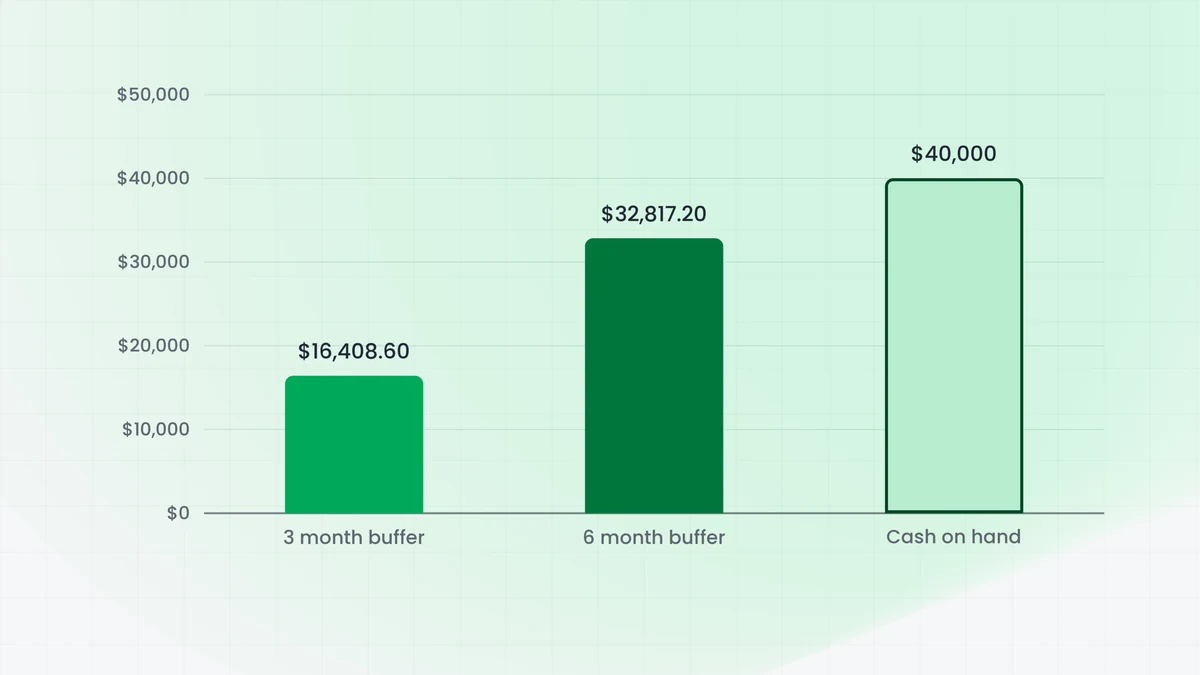
Surplus after repayments is $12,564.66 now, $12,530.47 after 25 basis points and $12,427.48 after 100, the four 2026 rises together. Three months of repayments is $16,408.60 at 25 points and $16,717.55 at 100; six months is $32,817.20 and $33,435.10. With $40,000 cash on hand the gap is $0 at every target, and surplus stays positive.
Now enter your own facilities, fixed ones included (the calculator leaves fixed facilities unchanged), then try three variations. Cash on hand of $10,000 instead of $40,000 turns the three-month gap at 25 points into $6,408.60 and the six-month gap into $22,817.20.
Quiet-quarter revenue of $66,000 with the 100 point chip turns surplus after repayments to $1,572.52 short each month, a runway of about 25 months of cash at that rate of loss. Facility 1 set to fixed cuts the extra at 25 points to $10.42, the line of credit alone.
Interactive calculator
Rate Rise Cash Flow Stress Test
Your facilities (up to three)
Default rates are an illustration, not a quote or an average. Put in the rate from your own statements.
Three facilities is the limit for this tool.
Rate shock (basis points)
100 basis points is one percentage point. Applied to variable facilities only. Assumes the lender passes on the full change; lenders set their own rates and timing.
Extra repayments a month after a 25 point rise
$34.19
A 25 point rise adds $34.19 a month across your variable facilities; monthly surplus goes from $12,565 to $12,530.
Monthly repayments by facility
Facility
Now
After
Extra
Facility 1: Term loanVariable, principal and interest
$4,977
$5,001
$23.77
Enter at least one facility with a balance to see its repayments.
Total
$5,435
$5,470
$34.19
Cash flow
Monthly surplus after repayments, now
$12,565
Monthly surplus after repayments, after the rise
$12,530
Cover now (operating surplus divided by repayments)
3.31 times
Cover after the rise (operating surplus divided by repayments)
3.29 times
Price rise that would absorb the extra, if volume held
0.04%
Buffer
Buffer target (3 months of post-rise repayments)
$16,409
Gap between the target and your cash on hand
$0
After the rise your surplus still covers repayments.
Uses average months; seasonal businesses should test their quietest quarter.
Cover is your operating surplus divided by repayments. Lenders calculate serviceability their own way, so this is a reading of your own numbers, not a lending test.
Assumes the lender passes on the full change from today to every variable facility. Lenders set their own rates and timing, and fixed facilities are left unchanged.
Before tax. Interest deductibility and any tax effect of the extra cost are for your accountant.
Estimate only, for general information. Not financial advice, a quote or an offer of finance.
Actual rates, fees and repayments are set by the lender and subject to approval and your circumstances.
The invented example: two variable facilities and one fixed, before and after the rise
Facility
Rate basis
Repayment now
After 25 points
After 100 points
Extra per month at 100 points
Variable term loan, $200,000 at 9.00%, 48 months, principal and interest
Variable
$4,977.01
$5,000.78
$5,072.52
$95.51
Line of credit, $50,000 drawn at 11.00%, interest-only
Variable
$458.33
$468.75
$500.00
$41.67
Total for the two variable facilities (the calculator's opening numbers)
Variable
$5,435.34
$5,469.53
$5,572.52
$137.17
For contrast: fixed-rate equipment finance, $60,000 at 8.50% fixed, 60 months (not in the opening numbers; add it as facility 3)
Fixed
$1,230.99
$1,230.99
$1,230.99
$0
Which facility should I review first?
Start with the largest variable balance, where most of the dollars are: $95.51 of the example's $137.17 comes from the term loan. Then any interest-only facility, because its whole balance reprices. Fixed facilities last: a fixed rate holds until its fixed period ends, so note that date, because the facility reprices then at a rate the lender sets. The break-even maths of fixing covers that moment.
How do I run a rate rise cash flow check?
A rate rise cash flow check works through six steps, from listing every facility to comparing your cash with a buffer target. It applies the rate change only to the variable facilities, so fixed ones do not move. You end with the extra monthly cost, the surplus left, the price rise that would cover it and your buffer gap.
List every facility. Write down each loan, line of credit, overdraft and equipment contract with its balance, rate, remaining term, whether the rate is fixed or variable, and whether you pay principal and interest or interest-only. In the worked example that is a $200,000 variable term loan and a $50,000 drawn line of credit.
Work out this month's total repayment across all facilities. Add up what every facility costs you this month. The example totals $5,435.34: $4,977.01 on the term loan and $458.33 of interest on the line of credit.
Apply the rate change to the variable facilities only. Recalculate each variable facility at the higher rate and leave fixed facilities unchanged. At 25 basis points the example rises to $5,469.53, an extra $34.19 a month; at 100 basis points it rises to $5,572.52, an extra $137.17.
Subtract the new total from your monthly operating surplus. Operating surplus is revenue less operating costs before loan repayments. The example's $18,000 surplus leaves $12,530.47 after repayments at 25 basis points, and repayment cover of 3.29, down from 3.31.
Convert the extra cost into the price rise that would cover it. Divide the extra monthly cost by monthly revenue. In the example $34.19 divided by $80,000 is 0.04%, and $137.17 is 0.17%: the across-the-board price increase that would absorb the rise if sales volume held.
Compare cash on hand with a three or six month repayment buffer. Multiply the new monthly total by three and by six and compare each with the cash you hold. The example needs $16,408.60 for three months and $32,817.20 for six, both covered by $40,000 cash. If surplus turns negative, cash on hand divided by the monthly shortfall is your runway in months.
How much cash buffer does a small business need after a rate rise?
There is no universal figure, but a common working range is three to six months of total loan repayments held in cash or an undrawn facility you control. Three months covers a slow quarter; six covers a slow quarter plus a shock. The right number depends on how seasonal revenue is and how fast you can cut costs.
The calculator shows the gap to each target. On the worked example at 25 basis points:
Three months of repayments: $16,408.60. Covers a slow quarter, not a second shock in the same quarter such as a lost customer or one more rise.
Six months of repayments: $32,817.20. Covers the quarter plus one more rise or a lost customer, at the cost of more idle cash that could be working capital.
Cash on hand of $40,000 covers both targets in the example; at $10,000 the gaps are $6,408.60 and $22,817.20. A seasonal business should enter its quietest quarter divided by three, because an average month hides the quarter where the shortfall appears. The buffer is sized on total repayments, not on the single-loan arithmetic in what the RBA rate rise adds to one business loan repayment.
The invented example holds enough cash for either buffer target. Drop cash on hand to $10,000 in the calculator and the gaps appear.
What is repayment cover, and how do lenders look at it?
Repayment cover is your operating surplus divided by your total loan repayments. A result of 2.0 means surplus covers repayments twice over; 1.0 means nothing is left. Lenders use their own versions of this test, often called serviceability or debt service coverage, with their own adjustments and buffers. Treat the calculator's figure as a health check, not a lender's verdict.
In the example, cover is 3.31 now, 3.29 after 25 basis points and 3.23 after 100. Drop revenue to a quiet-quarter $66,000 and apply 100 points, and cover falls to 0.72: an operating surplus of $4,000 against repayments of $5,572.52.
Should I pass the extra cost on to customers or absorb it?
Start with the arithmetic: the extra monthly cost divided by monthly revenue is the across-the-board price rise that would cover it if volume held. Whether volume holds is the real question; AMP economist My Bui said on 6 October 2026 that tightening household budgets limit how far businesses can pass on input price rises.
In the example that is 0.04% at 25 basis points and 0.17% at 100. Whether a move that size is noticed depends on your customers and competitors, not the arithmetic. Five common responses, none a recommendation:
Pass on or absorb: five responses to the extra monthly cost
Response
What it does to margin
What it does to cash
Risk
When it tends to fit
Pass on fully
Held
Held, if volume holds
Volume may fall if customers are stretched
Few customer alternatives; the rise is small in dollars
Pass on partly
Trimmed by the share not passed on
Falls by the same share
Lower volume risk, slower margin erosion
Mixed price sensitivity across customers
Absorb and cut costs
Held, if the cuts match the extra
Held
Cuts can hurt capacity or service
Costs were due a review anyway
Absorb and draw a facility
Falls by the extra
Held short term; interest adds to the extra
Interest-only balances are the most rate-sensitive debt, so the gap grows if the shortfall is permanent (see the line of credit section below)
A timing gap with a visible end, not a permanent shortfall
Restructure debt
Depends on the new facility's total cost, not its headline rate
Monthly cost may fall
A longer term can mean more total interest, and fees apply
Several facilities could be compared or consolidated on written quotes
What does the rate rise do to ATO debt on a payment plan?
The ATO's general interest charge is reset every quarter from a market rate plus a fixed uplift. A higher cash rate therefore tends to flow into a higher GIC with a lag. The ATO's GIC is 11.51% p.a. for the October to December 2026 quarter, up from 11.43% in the July to September 2026 quarter.
The rate is set under the Taxation Administration Act 1953. The base rate for a quarter is the RBA's 90-day bank bill average for the month two months before the quarter starts, plus 7 percentage points. For October to December 2026 that month was August 2026, when RBA Statistical Table F1.1 put the average at 4.51%; 4.51 plus 7.00 is the ATO's 11.51%. The figure was therefore set before the 29 September decision and is not a consequence of it.
GIC is an interest charge, not a penalty. Deductibility and the plan-or-loan maths are in our guide to the ATO payment plan against paying it out: the 2026 maths and are not repeated here. Lender appetite for ATO arrears varies and is the lender's decision, and this article does not suggest borrowing to pay tax.
Enter the ATO balance, the plan length and the current quarter's GIC to see the two costs side by side, then take both figures to your accountant.
Interactive calculator
ATO Payment Plan vs Loan Payout Calculator
$
$1,000 to $5,000,000.
The balance you would either put on a plan or pay out.
%
0% to 60%.
Used to show the after-tax cost of the loan. GIC is not tax deductible from 1 July 2025, so its cost is not reduced.
Cheaper after tax on these inputs
ATO payment plan
On these inputs the ATO payment plan costs about $79.24 less after tax than the loan payout.
ATO payment plan
Monthly instalment
$4,252
Total GIC
$3,023
Fees
$0
Pre-tax cost
$3,023
After-tax cost
$3,023
Loan payout
Monthly repayment
$4,265
Total interest
$3,177
Fees
$960
Pre-tax cost
$4,137
After-tax cost (25.0%)
$3,103
Difference after tax
$79.24
GIC compounds daily at the ATO; this estimate compounds monthly (annual rate divided by 12), which slightly understates the true charge.
GIC is not tax deductible from 1 July 2025. Interest and fees on a business-purpose loan are generally deductible; your accountant should confirm.
The ATO may require an upfront payment before accepting a plan, and may decline or cancel one. A broker cannot arrange an ATO payment plan; only you or your tax agent can.
The after-tax comparison assumes the business has taxable profit in the year. If it is in tax loss, compare the pre-tax lines.
Estimate only, for general information. Not financial advice, a quote or an offer of finance.
Actual rates, fees and repayments are set by the lender and subject to approval and your circumstances.
When does a line of credit help with a rate rise, and when does it just add interest?
An undrawn line of credit helps as a buffer: interest is charged only on what you draw, and it covers a timing gap without a new application. Any fee on the undrawn limit is set by the lender. It adds cost when drawn to cover a permanent shortfall, because interest-only balances are the most rate-sensitive debt you can hold.
The $50,000 drawn line in the example adds $10.42 a month at 25 basis points and $41.67 at 100. That is the smaller dollar change of the two facilities, but the only one where the whole balance reprices. Undrawn, the same limit adds nothing to the stress test and sits behind cash as a second layer of buffer. It is not cash, though: an undrawn limit is the lender's to review or reduce. Use it for gaps you can see the end of.
Which facility fits which gap is covered elsewhere on the site:
Our line of credit page explains how we arrange one. 121 Brokers can price a buffer facility across a panel before the quiet quarter rather than during it; whether a limit is approved, and at what size, is the lender's decision. Start with a scenario call with your statements and the calculator's numbers; for the application side, see how to get a business loan in Australia.
What economists expect next, and why it is not a promise
Figures in this section are as at 7 October 2026 and are reviewed after each RBA meeting; the next is 2 to 3 November 2026.
On 4 October 2026 the Australian Financial Review's survey of 37 economists found that 16 expected at least one more rise and 21 expected the next move to be a cut. The same AFR survey put the broad view of a first cut at November 2027. For a cash flow plan that means testing both 25 and 100 points and holding a buffer that survives either. These are forecasts, dated, not promises.
The range is wide because the inputs are. The same AFR survey of 4 October 2026 reported core (trimmed mean) inflation at 3.6% against the RBA's 2.5% target, and oil above US$100 a barrel against closer to US$70 before February 2026. It also reported ANZ forecasting a rise to 4.85% in November 2026, Commonwealth Bank and NAB forecasting no change, and markets pricing roughly a one-in-four chance of a November 2026 rise.
The RBA's Monetary Policy Board statement of 29 September 2026 also gave its guidance. It said: "The Board will continue to do what it considers necessary to bring inflation sustainably back to target, including increasing the cash rate target further if needed." A buffer sized to the 100 point chip is the one plan that does not depend on any of these forecasts being right.
General information only, not financial, tax or legal advice. 121 Brokers is a finance broker, not a lender. The revenue, cost, cash and facility figures in the worked example are invented illustrations and the calculator's default rates are illustrations, not quotes. Repayment cover as calculated here is a health check; lenders assess serviceability their own way and make their own decisions, including on ATO arrears. The ATO general interest charge is quoted as published for the quarter named and changes each quarter. Nothing here suggests borrowing to pay a tax debt; discuss any tax debt with your accountant. Forecasts quoted are the dated views of the people and organisations named. Whether any facility is approved, and on what terms, is decided by the lender.
A cash flow buffer is cash, or an undrawn facility you control, set aside to cover operating costs and loan repayments through a period when income falls short. It is measured in months of cover, not as a percentage of turnover.
Is three months of expenses the right buffer for a small business?
Three months is a common starting point, not a rule. A business with steady weekly takings may hold less; a seasonal or project-based business often needs six months or more. The right figure is the one that covers your quietest realistic quarter plus a shock.
Does a rate rise affect a fixed-rate equipment loan in a stress test?
No. A fixed-rate facility keeps the same repayment until its fixed period ends, so the stress test leaves it unchanged and applies the rate shock only to variable facilities. Note the end date, because the fixed facility reprices then.
Should a seasonal business test its quietest quarter instead of an average month?
Yes. An average month hides the quarter where the shortfall actually appears. Enter the revenue and costs of your quietest realistic quarter, divided by three, and the buffer the calculator reports will be the one you need.
Does the ATO general interest charge go up when the RBA raises rates?
Indirectly. The general interest charge is reset each quarter from a market rate plus a fixed uplift, so higher cash rates tend to lift the GIC in a later quarter. The ATO publishes each quarter's rate on its website; for October to December 2026 it is 11.51% a year.
What is a rate rise stress test for a business?
A rate rise stress test recalculates every variable facility's repayment at a higher rate, then checks whether operating surplus still covers the total. It shows the extra cost, the surplus left, and how many months cash on hand would last if surplus turned negative.
Will a lender want to see my cash buffer when I apply for finance?
Usually, through your bank statements. Lenders look at closing balances, overdrawn days and how repayments have been met, which together show the buffer in practice. A visible buffer supports an application; the lender still makes its own assessment.
Does an undrawn line of credit count as a cash buffer?
Partly. An undrawn limit covers a timing gap without a new application, which is what a buffer is for. It is not cash: the lender can review or reduce the limit, and drawing it adds interest-only debt. Treat it as a second layer behind cash.