Borrow Now or Wait for Rate Cuts? The Real Cost of Waiting on Equipment
By 121 Brokers Team, Commercial finance brokerage
· 14 min read
· Published
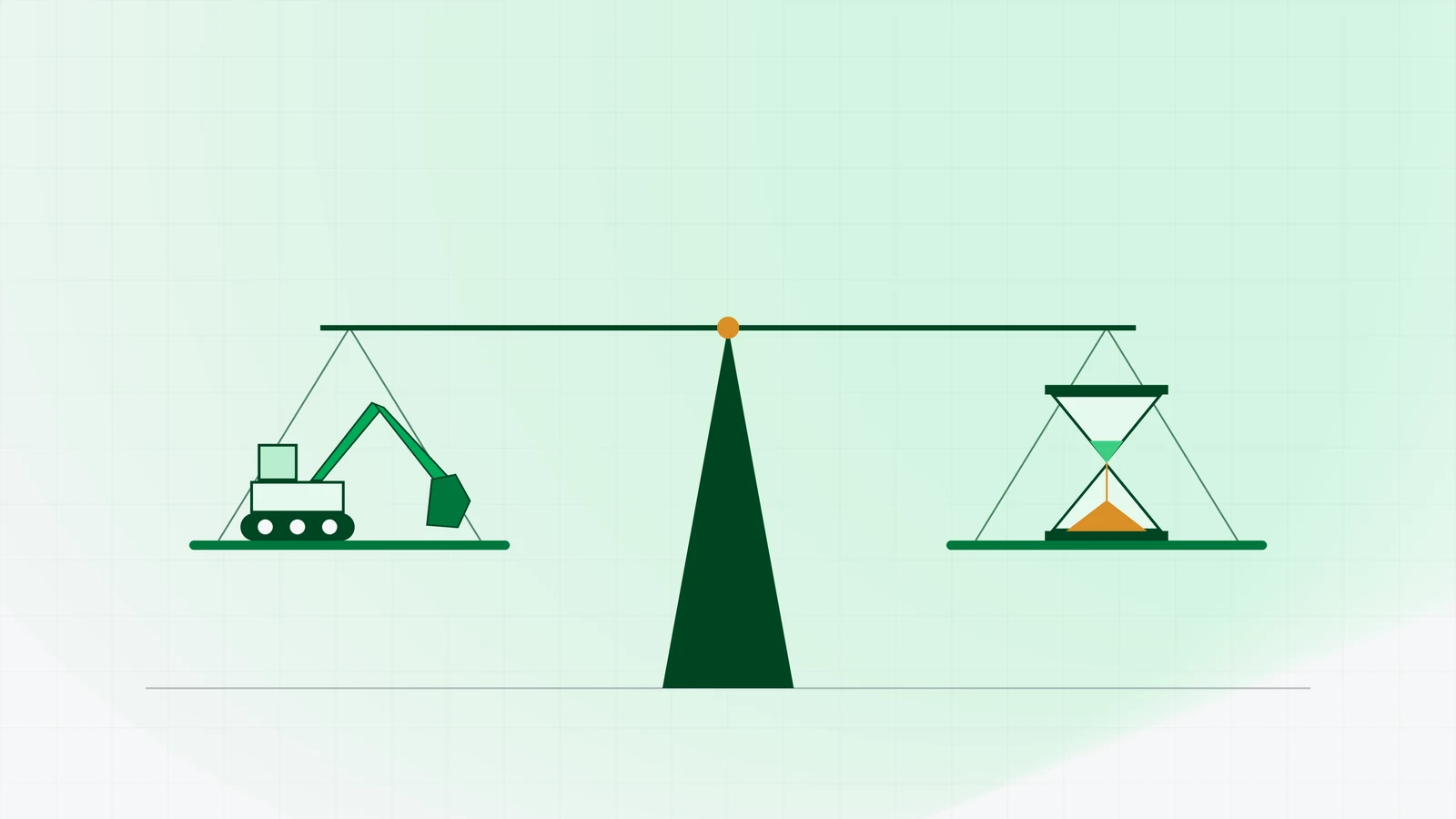
Waiting for lower rates to finance equipment pays off only when the interest saved beats three costs you carry while waiting. Those are any price rise on the asset, the income it would have earned, and what covering the gap costs. Nobody knows the rate path, so this guide shows how far rates must fall for waiting to win.
Should I wait for interest rates to drop before buying equipment?
It depends on three numbers, not on a forecast: first, what the asset would earn or save you each month. Second, what covering the gap costs you meanwhile (hire, repairs, downtime). Third, whether the price is likely to drift up while you wait. If those three exceed the interest saved, waiting costs more, and the calculator below runs your figures.
The question is live because of the RBA's latest decision. On 29 September 2026 the Reserve Bank of Australia's Monetary Policy Board raised the cash rate target by 25 basis points to 4.60%, the fourth rise of 2026. The cash rate is the rate banks pay to borrow from each other overnight, and a basis point is one hundredth of a percentage point. Equipment lenders set their own rates above it and decide how much of each move to pass on, and when.
On an equipment deal, the rate is rarely the biggest number. Half a percentage point on an invented $120,000 contract over five years is worth about $29 a month; a machine left idle for a year can forgo far more.
121 Brokers, an Australian business finance broker, arranges equipment and asset finance across a panel of lenders and leaves tax treatment to the client's accountant. We do not recommend buying now or waiting. Forecasts about the next rate move appear only in the section on what economists expect; everything before it is arithmetic you can check.
What does waiting to finance equipment actually cost?
Three things people forget to count, starting with foregone benefit: the net income or savings the asset would have produced in the months you waited. Second, stop-gap cost: hire, repairs or downtime on the old unit. Third, price drift: if the equipment costs more later, you finance more. Only after those three does the interest saving count.
Foregone benefit is the net amount the asset would add to the business each month if you had it now. For a machine that wins work, it is the extra gross profit after fuel, consumables and labour. For one that replaces a hire unit or manual labour, it is the saving.
Stop-gap cost is what you spend keeping the old arrangement going while you wait: hire charges, repairs on the unit you have, or days lost to breakdowns. Add up last year's repair invoices and hire charges and divide by twelve. If the old unit is paid off and reliable, this figure may be close to zero.
Price drift is the change in the asset's price between now and the day you buy. A dearer machine means a larger amount financed, so the lower rate is charged on a bigger balance and part of the saving disappears. Prices can also fall, which works in your favour.
The three costs people forget to count while waiting for a lower rate.
How far would rates need to fall for waiting to pay off?
Run both scenarios on the same asset and term: buy now at today's quoted rate, or in twelve months at an assumed lower rate. Count drift, benefit and stop-gap in both. The break-even is the later rate where the totals match. The worked example needs a fall of about 211 basis points, and your inputs will differ.
What 50 basis points changes on the repayment
Take $100,000 financed over 60 months with no balloon, a balloon being a lump sum left to pay at the end of the term. Moving from an illustrative 8.50% to 8.00% lowers the repayment by $24.01 a month, $288.16 a year and $1,440.82 over the term. On the $120,000 example below it is $28.82 a month and $1,728.99 over the term.
All loan amounts and rates in this example are invented illustrations, not quotes; 8.50% is the calculator's illustration rate, not a market rate.
The worked example
The calculator opens on neutral figures that produce no difference by design, so enter these to follow along:
Equipment price $120,000; deposit $0; term 60 months; balloon 0%.
Rate now 8.50%; months to wait 12; assumed rate when buying later 8.00%, which is your assumption, not a forecast.
Expected price change over the wait 0%.
Net monthly benefit of having the asset now $600; monthly stop-gap cost while waiting $0.
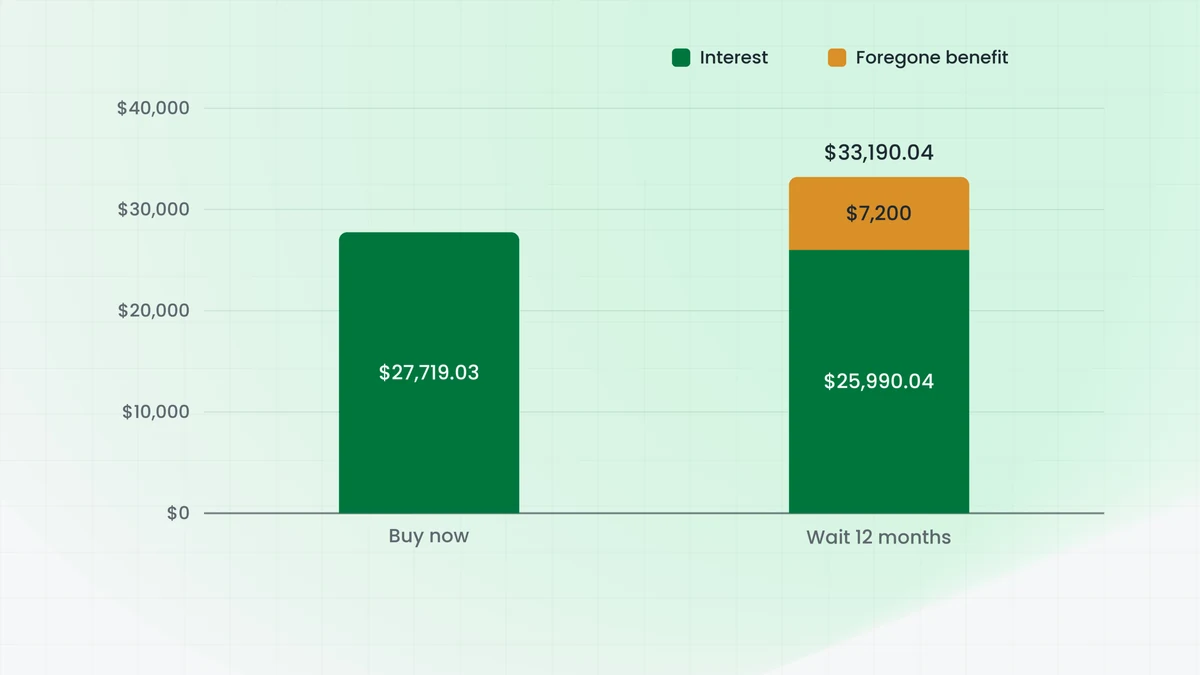
Buy now: the amount financed is $120,000 and the repayment is $2,461.98 a month. Total interest over 60 months is $27,719.03. There is no foregone benefit or stop-gap cost, because the asset starts work in month one. Total cost: $27,719.03.
Wait 12 months: the price is still $120,000 and so is the amount financed. At 8.00% the repayment is $2,433.17 a month and total interest is $25,990.04. The foregone benefit is $7,200, which is 12 months at $600, and the stop-gap cost is $0. Total cost: $33,190.04.
The difference. Waiting 12 months costs $5,471.01 more on these numbers, because the $1,728.99 of interest saved is smaller than the $7,200 of benefit given up. For the two to cost the same, the later rate would need to be about 6.4%, about 211 basis points below today's 8.50%.
First, try setting the net monthly benefit to $0: waiting now wins by $1,728.99, the pure interest saving, which is the case where the asset earns nothing for a year. Second, keep the benefit at $0 and set the price change to plus 2%, so the price becomes $122,400 and interest later is $26,509.84. Once the extra $2,400 on the price is counted, waiting costs $1,190.81 more. Third, enter your own quote, your later-rate assumption and a real monthly figure for the old unit.
Interactive calculator
Buy Now or Wait? Cost of Waiting Calculator
Cheaper before tax on these numbers
Neither
On these numbers buying now and waiting 12 months cost about the same.
Buy now compared with waiting
Item
Buy now
Wait 12 months
Price
$120,000
$120,000
Amount financed
$120,000
$120,000
Monthly repayment
$2,462
$2,462
Total interest over the term
$27,719
$27,719
Price change over the wait
$0
$0
Foregone benefit while waiting
$0
$0
Stop-gap cost while waiting
$0
$0
Total cost of the choice
$27,719
$27,719
Cost of waiting (positive means waiting costs more)
$0
Break-even sits at today's rate of 8.50%: any later rate below it makes waiting the cheaper leg on these numbers, and any rate above it makes buying now cheaper.
Tax treatment (instant asset write-off, depreciation, GST) is left out; ask your accountant.
Nobody knows the rate path; the assumed later rate is yours.
Total cost counts interest, the price change, the benefit you would miss and the stop-gap cost. The price itself and the deposit are paid either way, so they are shown but not added.
Rates, fees and approval are set by each lender and depend on the asset and your circumstances.
Estimate only, for general information. Not financial advice, a quote or an offer of finance.
Actual rates, fees and repayments are set by the lender and subject to approval and your circumstances.
Two caveats, in the calculator's own words. Tax treatment is left out, so ask your accountant. Nobody knows the rate path, and the assumed later rate is yours.
Buy now or wait 12 months: the invented $120,000 example
Line item
Buy now
Wait 12 months
Price
$120,000
$120,000
Amount financed
$120,000
$120,000
Rate
8.50% (illustration)
8.00% (assumed)
Monthly repayment
$2,461.98
$2,433.17
Total interest over 60 months
$27,719.03
$25,990.04
Foregone benefit
$0
$7,200
Stop-gap cost
$0
$0
Total cost
$27,719.03
$33,190.04
Difference
Waiting 12 months costs $5,471.01 more on these numbers
The invented example. Waiting saves $1,728.99 of interest and forgoes $7,200 of benefit, so it costs $5,471.01 more.
Does a fixed-rate equipment loan protect me if rates rise again?
Yes, for the term of the contract. Many equipment finance contracts, including chattel mortgages, are written at a fixed rate for the term; check your contract, because some facilities are variable. While fixed, the repayment does not move with later RBA decisions either way. The protection is also the trade-off: a cut after you sign does not lower the repayment.
If rates fall and you want out of a fixed contract early, ask the lender for a payout figure, the amount that clears the contract today. On a fixed-rate contract it can include an early payout charge or a break cost, the lender's charge for unwinding its fixed funding. Our guide to the break-even maths of fixing a business loan rate explains break costs in detail.
A written quote is valid for a period the lender sets, often measured in weeks, because its own funding costs move. Some lenders offer a rate hold, which keeps a quoted rate available for a short window after approval, sometimes for a fee; it holds the rate and nothing more. Ask about both in writing.
Which equipment finance structure suits a year of rate uncertainty?
A chattel mortgage, finance lease, hire purchase and rental each handle rate and ownership differently. A fixed-rate chattel mortgage locks the repayment and gives you ownership; a lease or rental may offer a shorter commitment and an upgrade path, at a different total cost. The table compares how each behaves if rates move. Structure is a separate decision from timing.
How four equipment finance structures behave if rates move
Lenders set their own terms, so the table describes common practice, not any one contract. Enter the quote's price, deposit, term and any balloon below, or on the full equipment and vehicle finance calculator page, to see the repayment. Try a 30% balloon and watch the monthly repayment fall while the residual, the amount still owing at the end, rises. For utes and trucks, see vehicle finance.
Because tax treatment depends on your entity, turnover, the asset and the rules in force in the year you buy, none of which a calculator should assume. Depreciation, GST credits and any instant asset write-off eligibility can change the after-tax picture materially. Ask your accountant before you decide; this guide compares pre-tax cash costs only.
Three terms your accountant will raise. Depreciation is the deduction for an asset's decline in value over time. Whether GST on the purchase price can be claimed as a credit, and when, depends on your own position and is a question for your accountant. An instant asset write-off, where it applies, changes the timing of the deduction; eligibility is a question for your accountant.
The structure you choose can change which of those applies and when, so settle it with your accountant first. Our equipment finance page answers common questions on deductibility, and our guide to what buying a $70k ute really costs walks through the tax side of one purchase. Neither replaces advice on your own position.
When is waiting the right call?
Waiting tends to win when the asset earns little until a specific date and the old unit is cheap to keep running. It also helps if the price is steady or falling and your rate assumption is below today's quote. It also wins when a new repayment would strain thin cash flow. None of those depend on predicting the RBA.
The worked example shows it. Set the net monthly benefit to $0, so the asset earns nothing for a year, with no stop-gap cost and a steady price. Waiting then wins by $1,728.99, the full interest saving. A machine bought for a contract that starts next winter can look like that.
Cash flow is the other honest reason. A new repayment of $2,461.98 a month lands on top of every facility you already hold, and the four 2026 rises have lifted the cost of variable debt wherever lenders have passed them on. Our rate rise cash flow check adds up every facility and shows the buffer worth holding before a new commitment. If the surplus is thin, the arithmetic can say buy while the buffer says wait.
The reverse case, where the asset is the thing that earns, is covered in our piece on why equipment financing matters. Both answers are legitimate; the three costs decide which is yours.
What economists expect next, and why it is not a promise
Figures in this section are as at 7 October 2026 and are reviewed after each RBA meeting; the next is 2 to 3 November 2026.
On 4 October 2026 the Australian Financial Review's survey of 37 economists found the broad view was a first cut in November 2027. ANZ forecast a rise to 4.85% in November 2026; Commonwealth Bank and NAB forecast no change. If the consensus is right, a cut is more than a year away. That is a forecast, not a promise.
Sixteen of the 37 economists surveyed expected at least one more rise, while 21 expected the next move to be down. Eight expected no cut before 2028. The survey reported that financial markets priced roughly a one-in-four chance of a rise in November 2026 and a move by May 2027. It put core (trimmed mean) inflation at 3.6% against the RBA's 2.5% target, with oil above US$100 a barrel against closer to US$70 before February 2026.
The RBA's Monetary Policy Board statement of 29 September 2026 said the following. "The Board will continue to do what it considers necessary to bring inflation sustainably back to target, including increasing the cash rate target further if needed." That describes the Board's approach; it is not a prediction of the next move.
Put the consensus into the calculator as a 13 month wait with your own later rate, then put ANZ's view in as a higher later rate. See which of your three costs decides it. The forecasts are inputs, and the asset's earning power is usually the larger number.
How do I compare an equipment quote today with one a year from now?
Five steps: today's written quote, your labelled rate assumption, the price in a year, monthly figures for benefit and stop-gap, and a total-cost comparison counting the foregone months. Each is short enough to do this week, and a broker can refresh the quote side when the time comes.
Get today's quote in writing. Rate, term, balloon or residual, establishment fee, account fees and how long the quote holds.
Write down your assumed later rate and label it an assumption. Run a second version 50 basis points higher to see what being wrong costs.
Estimate the price in a year. Ask the dealer what the model cost a year ago. If nobody knows, run 0% and plus 2%.
Put a monthly figure on benefit and stop-gap cost. Rough figures from last year's invoices beat a blank.
Compare total cost, foregone months included. The lower total is the cheaper path on your assumptions; the break-even rate shows how far they can be wrong.
121 Brokers can bring back equipment finance quotes from a panel of lenders for the buy now column, and refresh them if you decide to wait. Lenders set their own rates, terms and timing, and whether any facility is approved is the lender's decision. Start with a scenario call and bring the dealer's quote. Our guide to how to get a business loan in Australia covers the application side.
General information only, not financial, tax or legal advice. 121 Brokers is a finance broker, not a lender, and does not recommend buying now or waiting. The equipment price, rates, benefit and other figures in the worked example are invented illustrations, and the assumed later rate is an assumption, not a forecast. Tax treatment, including depreciation, GST and any instant asset write-off eligibility, is excluded; speak to your accountant. Forecasts quoted are the dated views of the people and organisations named, not predictions by 121 Brokers. Whether any facility is approved, and on what terms, is decided by the lender.
Are equipment finance rates fixed for the whole term?
Commonly, yes. Many chattel mortgages and leases set a fixed rate for the full term, so the repayment does not move with RBA decisions. Some facilities are variable or have a fixed period shorter than the term. Your contract states which applies.
If I finance equipment now and rates fall, can I refinance?
Usually you can ask for a payout figure and refinance, but a fixed-rate contract may include break costs or early payout charges that offset part of the saving. Compare the payout figure with the new quote before assuming a refinance helps.
Does a rate rise affect equipment finance I already have?
Not if the contract is fixed for the term, which many are. A variable equipment facility reprices when the lender moves its rate. Check the rate basis on your contract rather than assuming.
What is price drift and why does it matter when waiting to buy equipment?
Price drift is the change in the asset's price between now and when you buy. If the price rises while you wait, you finance a larger amount, which can cancel the saving from a lower rate. A falling price works the other way.
How long is an equipment finance quote valid for?
That is set by each lender and is often short, measured in weeks rather than months, because funding costs change. Ask for the validity period in writing. A lapsed quote has to be reissued, at whatever rate the lender offers at that time.
Does a balloon payment make an equipment loan more sensitive to the interest rate?
Yes, slightly. A balloon leaves a larger balance owing through the term, so more of each repayment is interest and a rate change moves the repayment by more than on a loan with no balloon. The calculator applies the balloon you enter.
Can an equipment finance rate be held while I decide?
Some lenders offer a rate hold for a limited window after approval, sometimes for a fee. It holds the quoted rate, it does not approve anything further, and the window is the lender's to set. Ask whether one is available.
Does waiting to buy equipment affect my borrowing power later?
Not in itself. Lenders assess serviceability on your trading, existing commitments and the asset at the time you apply. If your trading strengthens the assessment may improve; if revenue slips while the old unit struggles, it may not.