Running a business across the NSW and Queensland border from Tweed Heads
By 121 Brokers Team, Commercial finance brokerage
· 12 min read
· Published
A business with premises in NSW, customers in Queensland and staff on both sides of the line is normal at Tweed Heads and Coolangatta, and slightly unusual to a credit desk anywhere else. It stops nothing, but it needs to be presented as one coherent operation. Registration, payroll tax and workers compensation rules differ by state and belong with your accountant. 121 Brokers is a finance broker, not a lender, and not a tax adviser.
This article is for owners who trade across the border: the builder with a Tweed yard and Gold Coast clients, the retailer with a shop each side, the carrier whose trucks cross the line several times a day, the importer clearing through Brisbane. It describes what the border actually changes, sets out the vehicle registration rule with its official sources, hands the payroll and licensing questions to the right adviser, and then does the part we know: how a cross-border business reads to a lender and what to attach so it reads well. The local page is business finance broker Tweed Heads.
What the border actually changes
Tweed Heads sits on the NSW side of the Queensland border, adjacent to its twin town Coolangatta on the Gold Coast. The two share a tourism-based economy, Gold Coast Airport straddles the border into Tweed Heads West, and the Pacific Motorway bisects the urban area. The Pacific Highway runs four lanes from Hexham to that border, so the Tweed is the top of a freight spine that starts in Newcastle. In daily life the border is a line on a map that people cross for coffee. In paperwork it is a change of jurisdiction, and a handful of things change with it.
Where vehicles are garaged and registered. Each state requires a vehicle kept in that state to be registered there, on a time limit. Covered in detail below.
Payroll tax and workers compensation. Both are state schemes, with different thresholds, rates and rules on each side, and an employer with staff in both states has to consider wages across all states when working out where thresholds fall. An accountant's conversation, covered below without figures.
Licensing. Many trade and occupational licences are issued by state. A contractor licensed in NSW may need a Queensland licence or a mutual recognition step to work across the line.
Daylight saving. NSW moves its clocks in summer and Queensland does not, so for half the year the two ends of the same business are an hour apart. It affects settlement cut-offs, payroll runs and opening hours, and nothing else financial.
Banking and merchant settlement addresses. A merchant facility registered to a Coolangatta address and a bank account registered to a Tweed Heads address are the same business to you and, until explained, two addresses to an assessor.
Vehicle registration: the garaged address decides
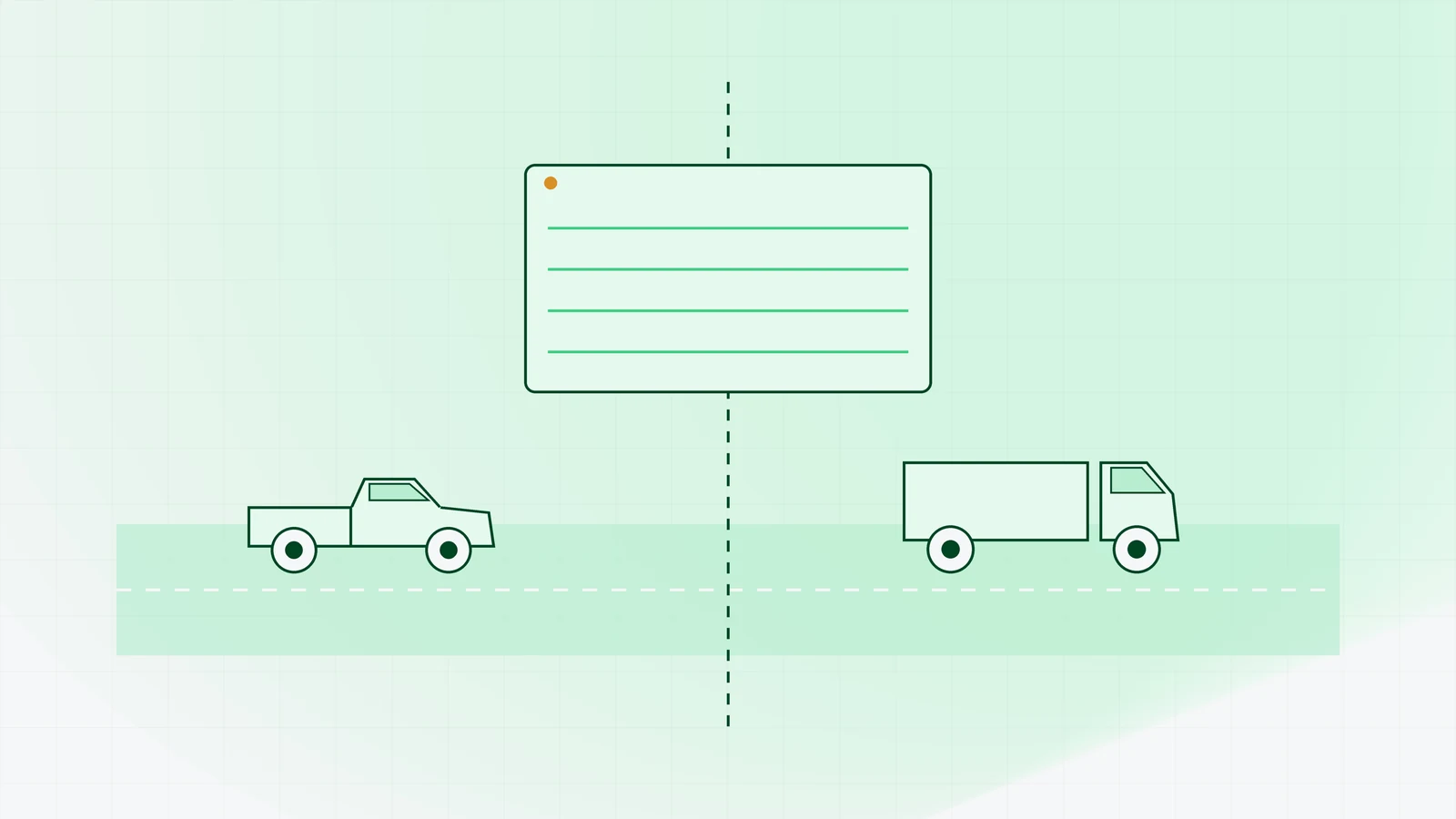
Which state a business vehicle must be registered in is decided by where it is kept, not by where the business is registered or where the driver lives. Service NSW states that a vehicle kept or garaged in NSW without NSW registration is treated as unregistered. The Queensland Government states that a vehicle garaged at a Queensland address must be registered in Queensland within 14 days, with a Queensland safety certificate, and interstate plates handed in. The official pages are Service NSW, transfer or register an interstate vehicle and Queensland Government, moving a vehicle to or from Queensland. Rules and time limits change; check the current page before acting.
For a fleet split across the line, that means each vehicle is registered where it sleeps, and a business can legitimately hold both NSW and Queensland registrations at once. For finance, it means one thing: the registration state on the financed vehicle should match where it is garaged, and both should match what the finance documents say. A lender's contract will reference the vehicle's registration and garaged address. If a ute is financed as a NSW vehicle and then garaged in Queensland, the registration has to move and the lender should be told; a mismatch that surfaces later is a conversation nobody enjoys.
Payroll, workers compensation and licences: an accountant's conversation
Payroll tax, workers compensation and some licensing are state matters and they differ between NSW and Queensland. Both revenue offices say the same thing about employers operating in more than one state: wages paid across all states are considered together when working out whether a threshold is reached. The official starting points are Revenue NSW, workers compensation and payroll tax and the Queensland Revenue Office, workers compensation and payroll tax.
That is as far as this article goes on tax. We do not quote thresholds or rates because they change and because we are finance brokers, not tax or legal advisers. How your wages are grouped, where your workers compensation policies sit and which licences you need on each side are questions for your accountant and, where relevant, a lawyer. Get them settled before a lender asks, because a lender will.
How a cross-border business reads to a lender
A national lender's assessor is used to a business that lives in one state. When the entity is registered in one state, the shop is in another, half the staff are on a different payroll scheme and the utes carry two colours of plate, the file is not worse; it is just more likely to be misread. The remedy is a one-page picture that makes the operation coherent before the assessor has to reconstruct it.
Six items do most of the work:
Entity registration state and trading address. Where the company or trust is registered, where it trades from, and why the two differ if they do.
Where staff are employed. A simple schedule: how many people, on which side, under which payroll and workers compensation arrangement.
Where assets sit and are registered. An asset register that shows each vehicle's garaged address and registration state, and where plant and equipment is located.
Customer concentration by state. Roughly what share of revenue comes from each side, and whether any one customer dominates.
Bank account and merchant facility addresses. Which accounts are registered where, and that they all belong to the one entity.
Tax registrations. ABN, GST, and where payroll tax and workers compensation are registered on each side, as confirmed by your accountant.
Presenting a cross-border business: what the lender sees and what to attach
Item
What the lender sees without explanation
What to attach
Entity and trading address
A company registered in one state trading from another; a possible inconsistency
ASIC extract, ABN details and one sentence on why the trading address differs
Staff location
Wages across two payroll schemes; unclear headcount
A staff schedule by state, with the payroll and workers compensation arrangement for each
Assets and registration
Vehicles on NSW and Queensland plates; unclear where the financed asset lives
An asset register with garaged address and registration state for every vehicle
Customer concentration
Revenue from two states with no sense of dependence on either
A customer summary by state and top customers by share of revenue
Bank and merchant addresses
Accounts and terminals registered to different addresses
A list of accounts and facilities, each tied to the one entity and address
Tax registrations
Unclear whether state obligations on both sides are in hand
Confirmation from your accountant of the registrations held in each state
One operation across a line: the six items that show a lender the two halves are the same business.
Which finance conversations this affects most
The border does not change what finance is available. Our lender panel is national, and a Queensland-registered business is as normal to it as a NSW one. What the border changes is which details need to be made explicit in each kind of application.
Vehicle and equipment finance where the asset crosses the line
Business vehicle finance and equipment finance are secured against the asset, so the lender cares where the asset lives. Make the garaged address and registration state explicit on the application and keep them consistent with the asset register. For utes and trucks specifically, our article on ute and truck finance in the Northern Rivers covers the vehicle side.
Invoice finance for builders and service firms with Queensland debtors
Invoice finance is assessed on the debtors as much as on you, so a Tweed builder or service firm with Gold Coast customers should expect the financier to look at those customers, their terms and their payment history. Debtors across the border are no obstacle; a debtor ledger that does not say which state each customer is in slows the assessment down. Our construction finance page covers progress claims and retentions.
Working capital and lines of credit for retailers selling to both sides
A business line of credit or an unsecured business loan is assessed on trading, so the question is whether the revenue picture is coherent. A retailer with a shop each side should present one set of accounts with the two locations shown, and merchant settlement reports for each terminal tied back to the one entity. See our retail finance page for the shape of that conversation.
Trade finance for importers using Brisbane or the Gold Coast
Trade finance pays the supplier and is repaid when the goods sell. Which port the goods clear through does not matter to the financier; that the importing entity, the customs broker's client details and the delivery address all line up does.
Four cross-border finance conversations: the detail that matters and what to make explicit
Conversation
The cross-border detail
What to make explicit
Where to read more
Vehicle and equipment finance
Where the financed asset is garaged and registered
Garaged address and registration state on the application, matching the asset register
Kingscliff, Murwillumbah and the rest of the Tweed
The border towns are not the whole shire. Kingscliff is a beach tourism town with cafes, shops and accommodation along Marine Parade, and its businesses run on the same summer calendar as the rest of the coast. Inland, Murwillumbah is the Tweed Shire administrative centre, and the rural land around it is used mainly for agriculture: sugar cane above all, with beef and dairy, and bananas, tropical fruit and other horticulture. The Condong mill on the Tweed River, operated by the grower-owned NSW Sugar Milling Co-operative since 1978, takes the cane. For those businesses the border is a market a short drive north rather than a daily crossing, and the lender questions are the ordinary ones about seasonal income and equipment. The business finance broker Tweed Heads page covers Kingscliff and Murwillumbah alongside the border towns.
Where we work from
Our office is at 5/12 Tasman Way in the Byron Bay Arts and Industry Estate, about forty minutes south of Tweed Heads. We have no premises in Tweed Heads, Coolangatta or anywhere in Queensland, and we would rather say that plainly than imply a Gold Coast office. We work with Tweed and Gold Coast businesses from Byron Bay by phone, email and video, and in person when it helps. Our lender panel is national, so a business registered in Queensland is as much within reach as one registered in NSW. For the region, see business finance broker Northern Rivers; for the range of facilities, our business loans page.
Next step
We are a broker, not a lender. What we do for a cross-border business is build the one-page picture above, place it with the lenders whose criteria fit the facility you need, and compare what comes back. The lender decides the amount and the terms. Compare your options, or book a call if you would rather start by talking through how the business is put together.
General information only: not financial, legal or tax advice, and it does not take account of your objectives, financial situation or needs. 121 Brokers arranges business-purpose finance only and is a broker, not a lender. Each lender assesses an application against its own criteria and decides the outcome, amount and terms. Vehicle registration, payroll tax, workers compensation and licensing rules are set by the NSW and Queensland governments and change from time to time; the official pages linked above are the current source, and your accountant or lawyer is the right adviser on how they apply to you.
Which state should a business ute be registered in if it is used on both sides of the border?
The state where it is kept or garaged, not where the business is registered or where it does most of its driving. Service NSW treats a vehicle kept in NSW without NSW registration as unregistered, and the Queensland Government requires a vehicle garaged in Queensland to be registered there within 14 days with a Queensland safety certificate. Check the current official pages, linked in this article, because rules and time limits change. This is a registration answer, not a tax one; tax treatment is for your accountant.
Does a lender care whether my business is registered in NSW or Queensland?
Not in itself; our lender panel is national and either state is ordinary. What a lender cares about is that the picture is coherent: the entity, the trading address, where the assets sit, where the staff are employed and where the revenue comes from all line up as one operation. The main risk with a cross-border file is that it is misread, and a one-page explanation prevents that.
Can I finance a vehicle registered in Queensland through a NSW-based broker?
Yes. We are a broker, not a lender, and the lenders on our panel write vehicle finance nationally. The lender's documents will reference the vehicle's registration state and garaged address, so those need to be accurate and consistent with where the vehicle actually lives. If the vehicle later moves across the border, the registration has to move with it and the lender should be told.
Do I need separate bank accounts for NSW and Queensland trading?
That is a business structure and accounting question for your accountant, not a finance requirement. Lenders do not look for a particular arrangement; they look for clarity. Whether you run one account or several, the application should list every account and merchant facility, tie each to the one entity, and show how revenue from each side flows through them.
What documents show a lender that my cross-border business is one operation?
The ASIC extract and ABN details, one set of financial statements covering both sides, a staff schedule by state with the payroll and workers compensation arrangement for each, an asset register showing each vehicle's garaged address and registration state, a customer summary by state, a list of bank accounts and merchant facilities tied to the one entity, and confirmation from your accountant of the tax registrations held in each state.
Does daylight saving or the time difference affect anything financial?
Only operationally. For part of the year NSW and Queensland are an hour apart, which affects settlement cut-off times, payroll runs and opening hours at the two ends of the business. It has no bearing on how a lender assesses an application or on any finance product. It is worth knowing when you set payment and settlement times; it is not a finance issue.
Are you based in Tweed Heads or on the Gold Coast?
No. Our only office is at 5/12 Tasman Way in Byron Bay, about forty minutes south of Tweed Heads. We have no premises in Tweed Heads, Coolangatta or anywhere in Queensland. We work with Tweed and Gold Coast businesses from Byron Bay by phone, email and video, and we come up the highway when a meeting is worth having in person.